
Preservative-free drug delivery is becoming increasingly important in nasal and ophthalmic medicines, where long-term or repeated use can make formulation tolerability a critical design requirement. For pharmaceutical manufacturers, the objective is to remove unnecessary preservatives while maintaining microbiological protection. Porous plastic components can support that objective by controlling air movement, filtration, and fluid flow within delivery systems
Traditional multidose liquids often include antimicrobial preservatives to reduce the risk of contamination during repeated use. In sensitive applications, preservatives such as benzalkonium chloride have been associated with tolerability concerns, particularly in chronic eye-care and nasal treatments. Preservative-free delivery moves the challenge of sterility from the formulation to the device. Instead of relying on a chemical preservative, the container closure system must prevent microbial ingress by incorporating sterilisation compatible materials, removing the backflow risk from the dispensed liquid, and filtering air during ingress.
This shift has direct implications for manufacturing teams. A preservative-free solution should be designed to minimise additional components and assembly steps. In order to maintain the devices compatibility with the formulation, robustness under repeated actuation and suitability for scalable production.
Porous plastics are engineered polymer structures with controlled pore size, airflow, permeability and geometry. In drug delivery devices, they can be used as vents, filters, wicks, reservoirs, flow restrictors or protective barriers. Their role is especially valuable when a device must admit air, manage pressure or move liquid without exposing the formulation to uncontrolled contamination routes.
For preservative-free nasal sprays and eye droppers, porous components can help balance microbial protection with device performance. Air replacement after dose delivery, for example, must be managed carefully. If air enters the pack, it requires filtration to maintain sterility within the product chamber. A porous plastic vent or filter can be designed to provide the required airflow resistance, filtration performance in an easy to assemble, manufacturable form factor.
Compared with membranes or metal mesh, sintered porous polymer components are not just self-supporting but can be moulded, machined or converted into repeatable shapes that integrate cleanly into plastic assemblies. This can simplify component handling, improve dimensional consistency and support high-volume manufacturing. Material selection also allows engineers to tune chemical compatibility, hydrophobicity or hydrophilicity, pore structure and mechanical strength to the requirements of the formulation and device design.
Nasal spray systems must deliver repeatable performance while protecting the formulation from contamination during repeated patient use. Preservative-free pumps therefore depend on mechanical and material features that limit microbial ingress, control venting air and maintain the integrity of the liquid pathway. Porous plastic filters and vents can contribute by supporting clean air exchange, reducing particulate entry and helping protect internal mechanisms from blockage.
In design and development, it is best to treat the porous component as a functional part of the delivery system rather than a passive insert. Pore size distribution, airflow, pressure drop, extractables profile, assembly method and sterilisation compatibility all influence final device performance. When specified early, porous plastic components can be designed around the pump architecture, target dose volume and expected in-use conditions.
Although in many ways similar to nasal sprays, ophthalmic delivery places additional emphasis on dose precision, ocular surface compatibility and microbiological quality. Multidose preservative-free eye droppers must allow clean, repeatable drop formation while preventing contaminated liquid or air from compromising the contents of the bottle. Porous plastic elements may be used to manage air compensation, regulate flow or support filtration functions within the delivery pathway.
For manufacturers, these details affect both product performance and patient experience. An eye dropper that requires excessive squeeze force, produces variable drops or dispenses inconsistently may undermine a user’s dosing and hence adherence to their plan. A porous plastic solution can be engineered to provide controlled permeability and stable flow characteristics, helping align device usability with formulation protection and manufacturing repeatability.
Successful preservative-free programmes require collaboration between formulation scientists, device engineers, quality teams and component suppliers. Porous plastic parts should be evaluated for biocompatibility, chemical compatibility, microbial challenge performance, dimensional tolerance, particulate control and assembly robustness. The earlier these factors are defined, the easier it becomes to build a strategy for scale-up.
Porous plastics also offer flexibility where standard components cannot meet the full device requirement. Pore size, thickness, diameter, shape and polymer grade can be customised to achieve specific airflow, liquid handling or barrier characteristics. This makes them suitable for concept development, device optimisation and commercial manufacture, especially where a nasal or ophthalmic delivery system must balance performance, protection and manufacturability.
Preservative-free drug delivery places greater emphasis on device engineering, material science and validated contamination control. For nasal sprays and eye droppers, porous plastic components can help manufacturers manage venting, filtration, dosing support and formulation protection within compact multidose systems. By designing these components around the product requirements from the outset, pharmaceutical manufacturers can support preservative-free performance without sacrificing usability, scalability or reliability.
Since FDA approval of the use of recombinant insulin (the first biopharmaceutical) in 1982 adoption of biological therapeutics has continued to grow to a market now estimated to be worth over $1.5T. The high specificity and activity of this class of therapeutics, coupled with reduced side effects compared with small synthetic molecules, is continuing to drive growth. Biomolecules approved for use in the treatment and prevention of human disease include vaccines, cell and gene therapies, hormones, enzymes, cytokines and antibodies. Monoclonal antibodies (MABs) are one of the fastest growing categories of biotherapeutics with more than 80 approved by the FDA in 2024. The current bottleneck for MAB development and acceleration of molecule discovery through automation is consumables, particularly at the 30-50 mL scale. The Clara™ filter plate system provides a fast and efficient solution for this challenge.
Discovery and development of large complex biomolecules requires biotechnological workflows distinct from the chemical synthesis processes used to produce small molecule therapeutics. Instruments and consumables for the development and scale up of biologics such as MABs has not kept pace with the growth of the industry – until now. PSL’s Clara™ 6 Well Filter plate set is uniquely designed for filtration and isolation of antibodies from up to 50 mL of culture. Developed with simple sample handling in mind the Clara™ system combines PSL’s expertise in porous materials, filters and membranes for biological applications with their plate moulding experience, enabling creation of solutions for rapidly scalable and automatable workflows.
The multi-layered Clara™ filter plates enable quick and easy separation of proteins from cellular debris and unwanted molecules produced during expression of proteins from bacterial, mammalian, plant, or yeast cell culture. Manufactured from virgin polystyrene with high optical clarity, the system allows easy observation of sample suspension flow and progress monitoring. The Clara™ system is fully compatible with vacuum and positive pressure manifold systems, including Tecan’s Resolvex A200 XT, for rapid processing in cell clarification or protein purification applications. Designed for performance, filter plates contain porous frits and 0.45 and 0.22 µm PVDF membranes to prefilter large molecules and remove contaminating bacteria in one quick and easy step. Fully customisable filter options are available and wells can be packed with a variety of purification resins. The filter matrix is supported by carefully engineered well base geometry, ensuring secure membrane positioning throughout the filtration process. Additional pre-filtration can be accomplished using the rigid top filter frit and optionally packed with resin, such as the diatomaceous earth typically used for CHO and HEK cell clarification.
The Clara™ 6 well Filter plate set includes a receiver plate with conical well bottom for maximum sample recovery, ideal for working with challenging molecules such as bispecifics and multispecifics with low expression levels. Tailored for efficiency, the Clara™ 6 well filter plate stacks securely onto its receiver plate whether handled manually or by robotic handling systems. Fully automation compatible, with dual grip point design, all Clara™ plates conform to ANSI/SLAS standards and available with barcoding for automated sample tracking and traceability.
For more information about the Clara™ 6 Well Filter Plate Set, please contact our team of experts here – int.sales@porvairsciences.com
Introduction
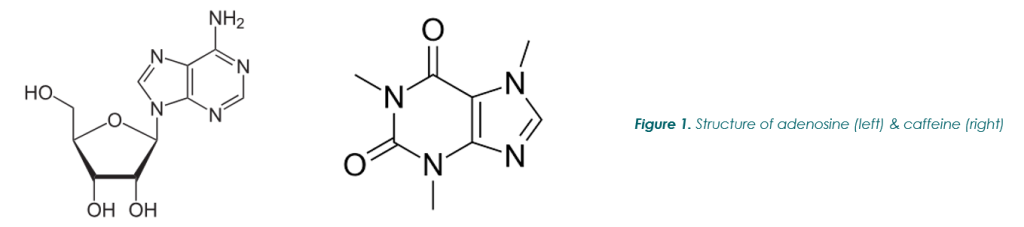
For centuries, the humble cup of coffee has been a popular part of daily life. Originating in Ethiopia and Yemen in the early 15th century, coffee has evolved into a vast global commodity, with an estimated 2.25 billion cups consumed each day. Stacking these cups on top of each other would create a tower 25,500 times the height of Everest. That’s a lot of coffee! One of the key ingredients that makes coffee so eye opening, pun intended, is caffeine. Within the body caffeine competes for, and binds to, adenosine receptors because of its structural similarity. These receptors are responsible for regulating physiological functions such as sleep. Thus, binding of caffeine in place of adenosine reduces the urge to sleep whilst causing a stimulating effect. This, in association with the other physical impacts of caffeine intake necessitates a recommended daily limit of 400 mg.
To celebrate international coffee day we decided to explore the coffee habits across the Porvair Sciences Wrexham site. Through combining high-performance liquid chromatography (HPLC) and the Microlute® CP HLB solid phase extraction (SPE) plate, we investigated how much caffeine was really in the coffee consumed.
Materials and Methods
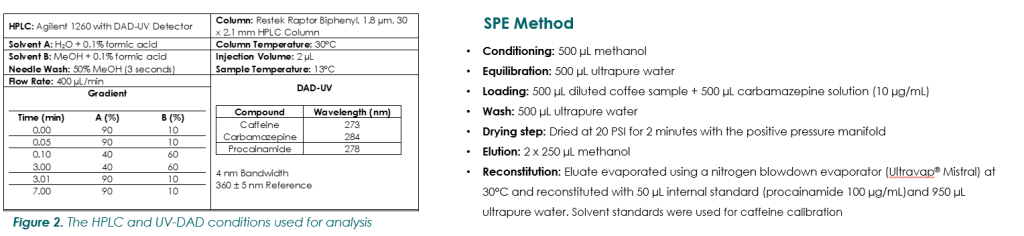
A questionnaire was used to gather data on the coffee habits and caffeine content perceptions of coffee brewed by individual participants. Coffee samples were taken directly from the brewed coffee, before the addition of milk, and diluted 1:30 in ultrapure water prior to sample clean up using a Microlute® CP HLB 96 well plate. Each sample was loaded in triplicate and processed using a positive pressure manifold (UltraPPMTM Lite) and nitrogen blowdown evaporator (Ultravap® Mistral).
A standard HLB Solid Phase Extraction (SPE) method was followed using two internal standards; the first was added during the sample loading step to correct for any aberrant recoveries from the SPE and/or evaporation steps, the second accounted for volume differences that may have occurred during instrument analysis.
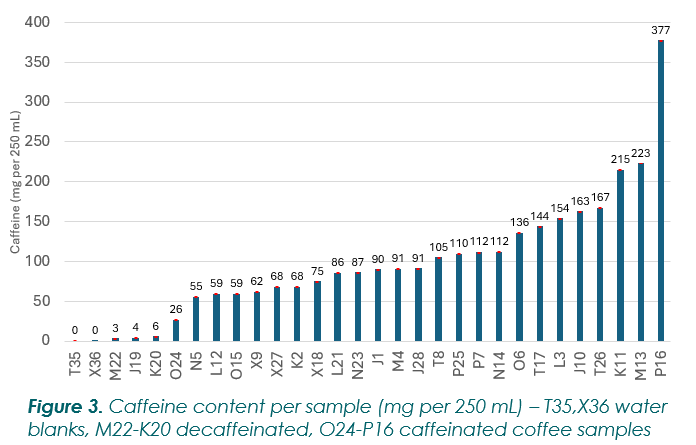
Total amount of caffeine per cup was calculated as the amount in 250 mL of coffee.
Results & Discussion
Conclusions
Find more information about the Microlute® CP HLB plates here or contact our team of experts directly – int.sales@porvairsciences.com
At Porvair Sciences, delivering an outstanding customer experience is at the heart of everything we do.
As part of the Porvair Life Sciences Group, we’re proud to harness the collective strengths of our partner companies – expanding our product portfolio and offering a wider range of complementary lab accessories.
We’re excited to announce that, thanks to our strategic growth and integration across the Life Sciences Group, Porvair Sciences now offers the full range of Kbiosystems laboratory instruments directly to our customers.
By collaborating closely with Kbiosystems, we’ve streamlined the design, supply chain, and production processes to deliver standard laboratory instruments with greater efficiency and at a more accessible cost.
Our mission is clear: to make high-quality lab instruments more accessible – faster, easier, and more cost-effective – for researchers, scientists, and institutions worldwide.
Contact our team today to learn how our integrated supply chain can benefit your laboratory needs.
T: +44 (0)1978 661144 or E: int.sales@porvairsciences.com
Find our instrument range here – Porvair Sciences laboratory instruments
Porvair Sciences introduces Clara™ 6 Well Cell Culture plates, the innovative solution for multi-well medium volume cell culture. Manufactured from virgin polystyrene their high optical clarity allows easy observation of cell health and density during growth.
The versatile Clara™ 6 Well Cell Culture plate is suitable for use with eukaryotic and prokaryotic cells. Perfect for mammalian cell lines, yeasts and E. coli cultures it provides the ideal solution for mid volume cell preparations for a variety of downstream applications including protein expression, plasmid propagation and transfection.
The unique round well design creates the optimal gentle media swirling motion during cell culture to prevent shear stress and cell damage during incubation, perfect for delicate cell lines such as Chinese Hamster Ovary (CHO) and hybridomas. Designed for scale up during biologics development, the 50 mL internal volume of the Clara™ 6 Well Cell Culture plate is suitable for culturing up to 20 mL of cell suspension per well, making it ideal for working with challenging molecules such as bispecifics and multi specifics with low expression levels.
The carefully engineered well geometry ensures that during incubation the rotating mechanism of incubators creates the optimal liquid movement motion within the wells for homogenous cell suspension. Facilitation of efficient oxygen transfer throughout the culture ensures healthy cells and high yield of product, providing predictable and reliable cell growth and protein or plasmid production.
Tailored for efficiency and ease of handling the Clara™ 6 Well Cell Culture plate is perfect for high throughput processing. Fully compatible with automation the unique dual grip point design of the Clara™ 6 Well Cell Culture plate makes it the most versatile plate available, suitable for use with the widest variety of robotic handling systems. The plates conform to the ANSI/SLAS standard footprint and are available with barcoding for automated sample tracking and traceability. For more information about the Clara™ 6 Well Cell Culture plate, please contact our team of experts here – int.sales@porvairsciences.com