Porous Plastics for Preservative-Free Drug Delivery
Preservative-free drug delivery is becoming increasingly important in nasal and ophthalmic medicines, where long-term or repeated use can make formulation tolerability a critical design requirement. For pharmaceutical manufacturers, the objective is to remove unnecessary preservatives while maintaining microbiological protection. Porous plastic components can support that objective by controlling air movement, filtration, and fluid flow within delivery systems
What Preservative-Free Delivery Means
Traditional multidose liquids often include antimicrobial preservatives to reduce the risk of contamination during repeated use. In sensitive applications, preservatives such as benzalkonium chloride have been associated with tolerability concerns, particularly in chronic eye-care and nasal treatments. Preservative-free delivery moves the challenge of sterility from the formulation to the device. Instead of relying on a chemical preservative, the container closure system must prevent microbial ingress by incorporating sterilisation compatible materials, removing the backflow risk from the dispensed liquid, and filtering air during ingress.
This shift has direct implications for manufacturing teams. A preservative-free solution should be designed to minimise additional components and assembly steps. In order to maintain the devices compatibility with the formulation, robustness under repeated actuation and suitability for scalable production.
The Porous Plastic Solution
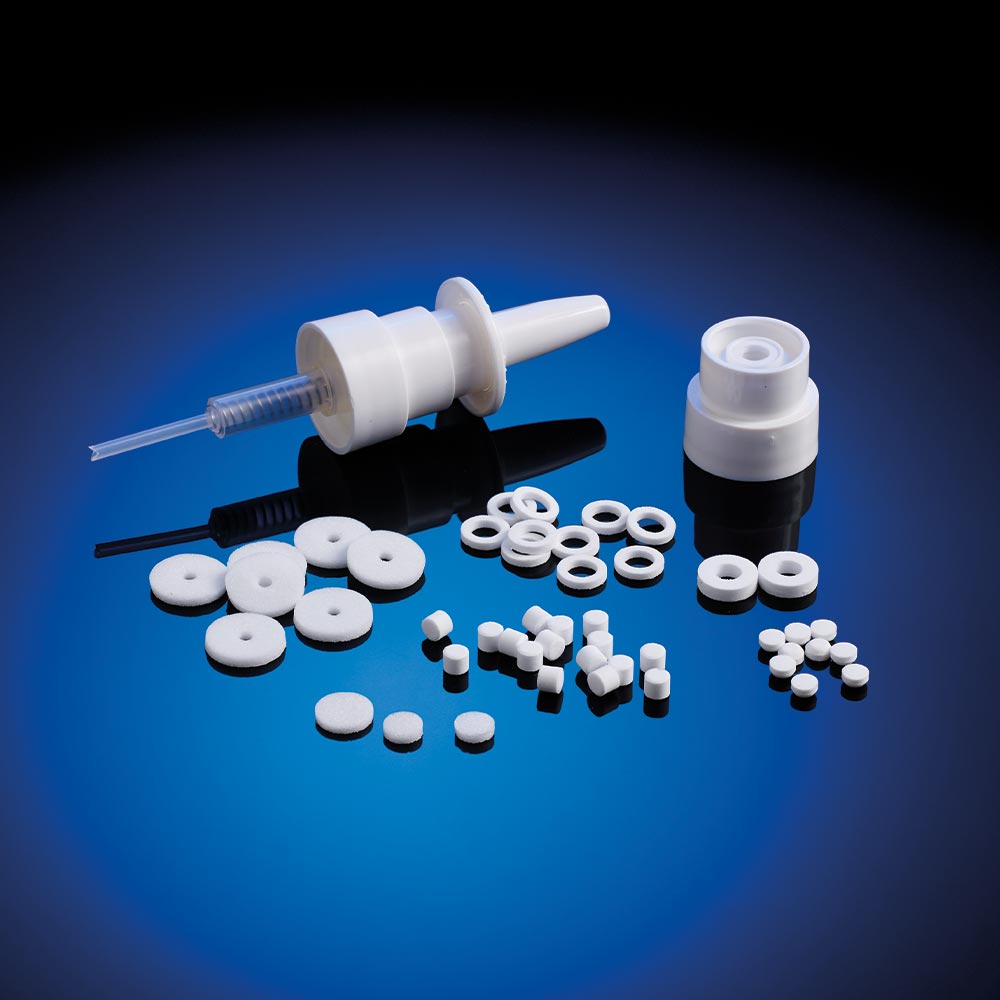
Porous plastics are engineered polymer structures with controlled pore size, airflow, permeability and geometry. In drug delivery devices, they can be used as vents, filters, wicks, reservoirs, flow restrictors or protective barriers. Their role is especially valuable when a device must admit air, manage pressure or move liquid without exposing the formulation to uncontrolled contamination routes.
For preservative-free nasal sprays and eye droppers, porous components can help balance microbial protection with device performance. Air replacement after dose delivery, for example, must be managed carefully. If air enters the pack, it requires filtration to maintain sterility within the product chamber. A porous plastic vent or filter can be designed to provide the required airflow resistance, filtration performance in an easy to assemble, manufacturable form factor.
Compared with membranes or metal mesh, sintered porous polymer components are not just self-supporting but can be moulded, machined or converted into repeatable shapes that integrate cleanly into plastic assemblies. This can simplify component handling, improve dimensional consistency and support high-volume manufacturing. Material selection also allows engineers to tune chemical compatibility, hydrophobicity or hydrophilicity, pore structure and mechanical strength to the requirements of the formulation and device design.
Nasal Sprays: Protecting the Pathway
Nasal spray systems must deliver repeatable performance while protecting the formulation from contamination during repeated patient use. Preservative-free pumps therefore depend on mechanical and material features that limit microbial ingress, control venting air and maintain the integrity of the liquid pathway. Porous plastic filters and vents can contribute by supporting clean air exchange, reducing particulate entry and helping protect internal mechanisms from blockage.
In design and development, it is best to treat the porous component as a functional part of the delivery system rather than a passive insert. Pore size distribution, airflow, pressure drop, extractables profile, assembly method and sterilisation compatibility all influence final device performance. When specified early, porous plastic components can be designed around the pump architecture, target dose volume and expected in-use conditions.
Eye Droppers: Precise Dose Control Without the Irritation
Although in many ways similar to nasal sprays, ophthalmic delivery places additional emphasis on dose precision, ocular surface compatibility and microbiological quality. Multidose preservative-free eye droppers must allow clean, repeatable drop formation while preventing contaminated liquid or air from compromising the contents of the bottle. Porous plastic elements may be used to manage air compensation, regulate flow or support filtration functions within the delivery pathway.
For manufacturers, these details affect both product performance and patient experience. An eye dropper that requires excessive squeeze force, produces variable drops or dispenses inconsistently may undermine a user’s dosing and hence adherence to their plan. A porous plastic solution can be engineered to provide controlled permeability and stable flow characteristics, helping align device usability with formulation protection and manufacturing repeatability.
Designing for Manufacture and Validation
Successful preservative-free programmes require collaboration between formulation scientists, device engineers, quality teams and component suppliers. Porous plastic parts should be evaluated for biocompatibility, chemical compatibility, microbial challenge performance, dimensional tolerance, particulate control and assembly robustness. The earlier these factors are defined, the easier it becomes to build a strategy for scale-up.
Porous plastics also offer flexibility where standard components cannot meet the full device requirement. Pore size, thickness, diameter, shape and polymer grade can be customised to achieve specific airflow, liquid handling or barrier characteristics. This makes them suitable for concept development, device optimisation and commercial manufacture, especially where a nasal or ophthalmic delivery system must balance performance, protection and manufacturability.
Conclusion
Preservative-free drug delivery places greater emphasis on device engineering, material science and validated contamination control. For nasal sprays and eye droppers, porous plastic components can help manufacturers manage venting, filtration, dosing support and formulation protection within compact multidose systems. By designing these components around the product requirements from the outset, pharmaceutical manufacturers can support preservative-free performance without sacrificing usability, scalability or reliability.